Friday, October 28, 2011

One Day at Rest, Painting 1


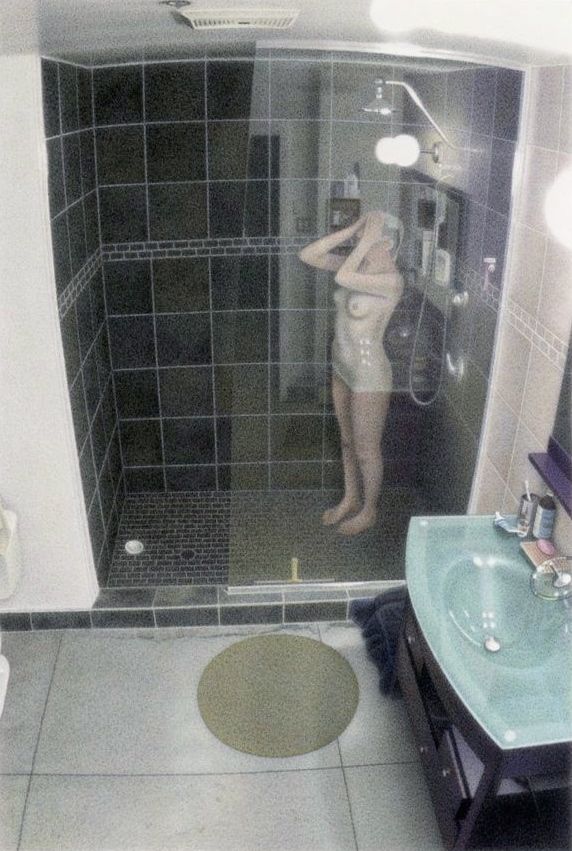
One Day at Rest, Untitled 1 (7:51 am), 2011
8 X 5.5" acrylic on illustration board


Now that the first painting for ‘One Day at Rest’ is finished, I’m pondering which images from that day will become drawings or etchings, figuring out a handmade book that I might make. I suddenly feel like an artist again instead of a machine for producing photorealist paintings.

I used all manner of materials when I was younger, the different media transforming the ideas I brought to them. What happened? Perhaps I was too eager to define myself. I’ve been so intently focused on producing a cohesive body of work in the last couple of decades, refining the definition of what I do, that I forgot to take time to experiment. The commercial gallery world, where I felt inclined to belong, likes to define things, needs to define things. The simpler the definition, the easier the sale.

Painting is exhausting. It consumes every ounce of concentration I can generate. For me, the end of the day means the end of thinking about art. I need to get away from my desk, blank out, go for a walk, watch television. Late in the evening I’ll think about the day of work I have ahead. In my mind, I go over the areas I’ll be tackling in the morning like a marathon runner crossing the country. Tomorrow, I’ll try to get to Calgary.

I’m excited enough about my new project that it’s dislodged decades of walls I’ve built around what it means for me to be an artist. During the several months that I work on a painting, I’m not sure I can do other things like drawings or prints, but the time between paintings, when I’m usually feeling unsettled, distracted, or guilty about not painting, suddenly seems like the perfect opportunity to experiment.

Sunday, October 16, 2011

A Way Forward


Digital photo 'One Day at Rest' (7:08 am) 02/07/2011.

On July second, 2011, I took more than 7,200 photos of a typical summer Saturday in our condo studio in Montreal. Four cameras, covering virtually every square inch of living space, recorded our existence from our waking at 7 am to lights out at 10:30 pm. The digital cameras were mounted surveillance style from the ceiling and at an interval of seven or eight seconds, one of the four cameras would silently record an image. I also carried a voice activated digital sound recorder throughout the day and recorded over eight hours of audio.

‘One Day at Rest’ is an attempt to further explore my perception of honesty, its nature and role in my work, and a more direct attempt at portraying my physical and psychological existence without the distorting filter that results from turning the camera outwards.

I’ve spent decades sporadically roaming the streets with my camera, subconsciously searching for subjects that reflected my mental state, my unease with the world. Every subject I painted spoke to me in this way, whether trailers, neon signs or derelict commercial buildings.

It took several years to consciously understand that I was searching for a way to reflect my damaged self, except I’d found a way to expose myself to the world without truly giving anything away. I hadn’t intended to perform this psychological dance of the seven veils, I thought at the time I was being pretty direct. I certainly felt the anxiety of the exposed, but a growing awareness of how people perceived my paintings made me realise I was on the wrong track.

In a gallery setting, my paintings look vaguely like photographs. Admittedly, like ink-jet photographs printed on cheap paper in fast draft mode. I’ve often explained to someone hustling past the images at an opening ‘By the way, these are paintings, not photographs!’ People would often do a double take and look a little closer but I began to feel that most were saying to themselves, ‘That could be a photo or it could possibly be a painting but I’m not interested enough to care.’ The current dogma of contemporary art appreciation doesn’t seem to allow for a small photo based painting. Ironic, given the preponderance and apparent popularity of rather dull photographs of abstract collages, photographs of paintings and photographs of photographs. I’m puzzled that people don’t seem to ‘get’ the work but I think they’ve been taught that there’s nothing to get.

When what I do no longer works for me, it’s time for a change. Art is communication and I feel that my message could do with a little reworking. It’s just an old building, how can I expect anyone to get that it represents my tortured soul, that it speaks of impermanence, mortality, alienation, the nature of and value we place on the production of culture? I’ve been hiding behind a facade, sometimes a literal facade, strangely, and it’s time to change how I show myself to the world.

Seventy two hundred photographs of me doing very personal things somehow didn’t make me feel any more exposed than my paintings of buildings or signs. For me, they are the same thing. I hope for the viewer they are something quite different.

Thursday, July 28, 2011

Sea Change


ABC United Trading Corp. 2011 5.5 X 8" Acrylic on illustration board.

ABC United Trading Corp. will likely be my last storefront for awhile. The changes I’ve made to get my paintings into a different realm in New York have had unexpected consequences. This ongoing process of recontextualisation has led me to a surprising revelation: It appears I’ve driven a car into the desert and run out of gas.

I’m not sure when, exactly, I ran out of gas. It may well have been long before I made it to New York for my first show at O.K.Harris in 2004. The twenty year drive to show my work at a good gallery in New York City somehow kept me from knowing that I was no longer inspired by what I painted.

The little ringing voices of truth that I imagine occupy a space just above and behind my head are most easily ignored when life is complicated. The more entanglements my life or career has, the more I ignore them. The blessed silence afforded by the odd confluence of a dying American economy, the strange weightlessness of an unsure venture with a new gallery, and my aching disinterest in my own work has finally allowed the voices to be heard above the din of self delusion.

Art is self exploration. This fact doesn’t always mesh well with a world that prefers to see culture entwined with commerce. The artist’s understandable preoccupation with the financial insanity of this kind of pursuit and the accompanying deviation from the purity of one’s truth is no longer an option for me.

The pressure we place on ourselves, or allow others to place on us, to proceed along a predetermined path to ‘success’ has the effect of eliminating from our lives the insignificant seeming non sequitur, the chance encounter which changes one’s entire direction.

I know now that there isn’t a goal. Only a direction to take and reevaluate when necessary. This is a journey whose length is indeterminate and unknowable and ends only when we ourselves end.

I can choose to find some gas and continue on or I can leave the car in the desert and find another road out. The immense relief I feel as I walk away in another direction is the answer to the question ‘Have I done the right thing?’

Monday, April 4, 2011

Living in Exile


Petemar Enterprises 2011, 5.5 X 8" acrylic on illustration board.

I’ve made two significant geographical moves in my life. The first, in 1989, from Toronto, Ontario to Victoria, B.C. (3397 kilometres). The second, in 2008, from Victoria back east to Montreal, Quebec (3733 km). Both moves gave me a sense of living in exile in one way or another. Both were largely financially driven but each also had an element of escape. The first, escape from the fold of family, old patterns of expectation, the ‘didn’t I know you in high school?’ encounter. The second, a licking of mid-life wounds, an almost random stab at the map for a new place to start again.

Perhaps the urge to move on is an inherited trait. My parents became postwar, economic exiles of Scotland when they made the difficult decision to move to Canada in 1950. Canada was a place of employment opportunities and where one could buy a dozen eggs if one wanted. The latter was no small consideration for a young family living in postwar food-rationed Glasgow.

My father never fully committed his heart to Canada despite spending a large majority of his life here. ‘Home’ for him was more than 5,000 kilometres from the house he shared with us. In a way, he never fully committed to the idea of a home with a wife and three children either. He once remarked to me as we stood looking at the backyard of the house I grew up in, ‘This would be good place to raise a family.’ I thought, ‘Actually, it was. Where the hell were you?’

Sometimes the moving on comes before one is actually ready to leave. Over the last year or two I’ve struggled to understand my place in the art world and tried to sort out why I don’t feel particularly comfortable with the ‘photorealist’ label, despite the obvious connection my work has to the genre. I know that I’ve moved on but I’ve had trouble falling into step with my new surroundings.

Exile is the removal of oneself from the realm of interest that so possesses the person in exile. The removal, which can heighten one’s desire to engage the mind with what was left behind can also, over time, allow for a dampening of the passions. So it is with my dying interest in photorealism.

Montreal isn’t home yet but it probably will be before long. ‘Moving on’ is more of a psychological transformation than a change in one’s address. It’s easy to pack a truck and move oneself physically but the ties one has to a place aren’t so easy to shake from the mind.

Wednesday, December 22, 2010

New Painting: 'House on Marconi'


House on Marconi 2010, 5.5 X 8" acrylic on illustration board.

It’s an odd sensation painting something that one walks by everyday. The subject of ‘House on Marconi’ sits only a few yards from our front door.

Over the last few months, during the daily dog walk, I’ve occasionally been tempted to check out details that were unclear in the source photograph but I mostly avoided looking too hard. There’s an awkward creepiness in paying so much furtive attention to someone else’s house. It’s not unlike developing an obsessive crush on the person who makes your soy latte every morning. Not that I would know anything about that.

Being so deeply immersed in a subject, as one is when spending three months painting it, is an unusual experience. All the more unusual given the prosaic nature of the subject. No one in the ‘real’ world ever spends that much time considering such a quotidian scene.

I have a complicated, subconscious response to my subjects that feels almost physical. It may be the sense of desolation or the inherent, sad beauty of the unremarkable facades but I get a strange feeling in the pit of my stomach when confronted by the scenes that become paintings. They act as clues to some long buried personal mystery, each one giving a sense of bringing me closer to resolution but never delivering a result.

As I sort through my slides looking for the subject of my next painting, I have to constantly remind myself that it’s the pit-of-my-stomach, anxiety-disorder, existential aloneness that I’m painting, not old houses, storefronts, or my neighbourhood. Certain examples of these things can trigger in me the feeling I’m wanting to explore but aren’t, in and of themselves, a reason to paint.

Wednesday, December 15, 2010

Performance Ritual


Recently, I filmed an entire day of my painting process, my ‘Performance Ritual’. It was an exhausting day. I had a long list of shots I needed to illustrate the typical day in my studio beginning with the first few moments after waking at seven to the final marking of my time sheet and extinguishing of my lamp at five.

Much of what I wanted to record was the cycle of activity outside the walls of my condo-studio. In my isolated art-bubble, the daily routines of the mechanics, the body shop, the commuter train, the school bus depot, embrace me as part of the larger world of work. In our previous neighbourhood, a family filled street of brick duplexes and triplexes whose facades ran unbroken from one end of the block to the other, the daily exodus for work or school left the neighbourhood eerily quiet, the conventional nature of life there only accentuating the isolation that an artist can sometimes feel.

I’ve connected ‘work’ with my art since I quit my job to explore the possibility of painting full time in 1983. A combination of guilt and an overblown presbyterian work ethic ensures that my practice is a sober one. I’ve never owned an easel or a palette or worked with more than one brush although I will admit to wearing a beret in snowstorms in the eighties.

My improbable choice of working surface, a metal, sixties office desk and my lifelong fascination for offices and office supplies and equipment no doubt stems from my Father’s long held job at an insurance company whose offices were a repository of oddballs and cranks that I mostly feared and my Mother’s job in the sixties, cleaning offices from which she’d return, late at night, with the discards of Union Carbide: outdated stationery, Eveready Battery signs, battery testers and odd product labels on sheets.

As a child I endured one or two Christmas parties at my Father’s workplace and one staff picnic of which my only memory is getting lost and tearfully searching for my Father among the drunken adults. While the office discards of reams of paper and other supplies kept me busy as a kid, my Father mostly kept this part of his life separate from his family and bred in me a resentment for this other ‘family’.

I’m always fascinated by how well buried are the roots of our present day actions. My intuitive desire to film a day of work juxtaposed with the routines of the workers outside my studio brought home to me, yet again, the connections between our childhood experiences and the sometimes puzzling choices we make as adults.

Monday, December 6, 2010

The Artist's Statement


Rosedale Manor 2007, 5.5 X 8" acrylic on paper.

The artist statement is an odd document. The bastard child of art and literature, often neither artistic nor literate. It is to art what ‘compulsory figures’ were to nineteen sixties figure skating competitions: an adjudicated series of prescribed moves which relate only marginally to artistic expression.

I’ve always resented and resisted the kind of statement that results in successful grant applications. Not surprisingly, I haven’t had many successful grant applications. When I think of a juror on a grant committee, I transpose, in my mind, an elderly East German figure skating judge: a stooped man in a drab overcoat, peering at the cuts on the ice and marking his card in the manner of the juror checking off the currently acceptable phrases and concepts.

Though I’m convinced no one has ever read any of my statements, I’ve always found them to be a good way to crystalise an explanation of what my subconscious is trying to accomplish in my work. A way of conveying to the average person the intent behind a seemingly nondescript collection of images.

My most recent statement for Jim Kempner Fine Art is marginally more ‘art world’ than usual for me but given my new audience and a burgeoning awareness of some long hidden concepts in my process, it seemed appropriate.

Please forgive me for referring to ontology.

*****

Artist’s Statement:

In 1993 I began using photo based imagery in order to eliminate the identifiable marks I make as an artist. In practice, using a single photographic slide as reference and adhering strictly to the information presented in the image is as close as a realist painter can get to objectivity. By restricting my palette (two reds, two blues, yellow and black) the size of the paintings (5.5 X 8”) and by using a single brush (an inexpensive #6 gold sable) I’ve further eliminated many subjective decisions from my process.

I don’t seek out my subjects. They emerge from the periphery of awareness and are almost entirely buildings which have achieved a level of invisibility in their surroundings. The kind of invisibility that heralds transformation: renovation; destruction. I’m interested in the ontological question of being: If it’s ‘invisible’ to everyone, does it exist?

Monday to Friday I work at an old office desk from 9 am to 5 pm. I begin the day by removing the paints from a drawer on my left and placing them on the desk. I remove the painting from a box in front of the desk. At noon I break for lunch and record my morning’s hours on a time sheet that I keep in a drawer on the right. At 12:30 pm I resume working until 5 pm when I record the afternoon’s hours on the sheet. This ritual contravenes the notion of the artist as free spirit, presenting instead the artist as worker, toiling to create an article of cultural consumption. The product is a much fetishised image on board: the average 5.5 X 8” painting requiring 280 hours to complete from a slide exposed at 1/60th of a second, a time factor of 60,480,000 to 1.

I’ve come to accept the folly of hoping to eliminate the self through representative imagery but I’ve managed what is, for me, an acceptable level of detachment from my subject and the physical object of the completed painting through the restrictions I’ve imposed on my process.


Neil MacCormick

September, 2010.

Wednesday, October 20, 2010

The Cliff


Being an artist means sometimes doing what seems most frightening. Normally, the days go by in a pleasant kind of tedium, a feeling that work is getting done. After so many years of refining a process, there’s little to sort out beyond the logistics of how one tackles the next area to be painted. The mind often fixates on other less immediate things like ‘Why is my ankle sore?’ and ‘What the hell is up with my art career?’ The latter question usually precedes a sickly feeling in the stomach and an effort to get back to wondering about the ankle.

Lately, I’ve been thinking a lot about my career. Beyond changing the way the paintings are presented in their frames or the desire to call myself something other than ‘photorealist’, I’ve felt a growing urge to find a new audience for my work. It’s either a hazard of my psyche or my trade but the days spent painting while simultaneously deconstructing every decision I’ve ever made sometimes results in finding a question that needs to be answered: “Can I place my work in the larger context of contemporary art and escape the confining clutches of ‘photorealism’?”

Managing one’s art career isn’t something people talk about. I certainly don’t think it’s something anyone teaches, only the individual artist can visualise the path forward. For me, the persistent itch of dissatisfaction for my lot is what drives most of my career decisions. The ‘itch’ is something I feel is crucial to the development of one’s art, never mind one’s career. Complacency and satisfaction toll the death knell for originality.

With this in mind, I made a bold move and in my ever-expanding search for a new context, I ended my six year relationship with O.K. Harris in SoHo and found a new starting point as the only photo-based painter at Jim Kempner Fine Art in Chelsea. The change came quickly when I finally puzzled out what change was needed. Like a tectonic plate, I can sometimes shock myself and those around me by making an unexpected move.

If we’re lucky and if we’re open to it, life can take us to unexpected places. Two years ago, I couldn’t have imagined leaving the security of O.K. Harris. As I walked out of Kempner, having dropped off three paintings to meet their fate in Chelsea, I felt like I had just jumped off a cliff. I’d set in motion something whose outcome was unclear to me. I walked to the end of 23rd street and composed myself on a bench in the park at Chelsea Piers, assuring myself that I’d done the right thing.

Whether or not my work finds its audience at Jim Kempner, I feel now that the important thing, as an artist, was jumping off the cliff.

Monday, September 27, 2010

New Painting: 'Oriental(e)'


Oriental(e) 2010, 5.5 X 8" acrylic on illustration board.

Oriental(e) is a tofu manufacturer located a short block from our condo/studio. It has that beyond-its-best-before-date look. In our neighbourhood, that means a new condo will rise in place of a freshly razed building and the empty lot next door. The building is, in fact, for sale for less money than we paid for our condo. If not for the intimidating and expensive prospect of converting it to a studio, we’d be buying. Who doesn’t want a garage door entry to their studio? I’m assuming the mice would leave with the dearth of tofu manufacturing but maybe that’s a mistaken assumption on my part. The lot next door might be unavailable to developers as it’s ‘occupied’ by a mysterious person or persons in a tent. In over a year we have yet to figure out what goes on beyond the hoarding that hems in the property. We do indeed live in a curious neighbourhood.

The slide from which I painted ‘Oriental(e)’ was taken after the building’s ‘For Sale’ sign fortuitously blew off in a storm. I hadn’t managed a good photo of the building before the sign went up and I didn’t want a shot of the building with the sign. One of my rules is to use only one slide per painting. The only manipulation I allow to the photo is a subtle cropping to centre the image. I use a slide viewer through which I peer at the small section of the image on which I’m working. The completed image often comes as something of a surprise. Having concentrated for several months on such small parts of it, the whole of the image seems quite fresh to my eyes. I often have to rack my brain to remember which painting I’ve just completed.

‘Oriental(e)’ is a perfect illustration of the transitional building I find so appealing. A nondescript structure just at the edge of its usefulness in a changing neighbourhood. One day no one will remember it was there.

I’ve come to accept that transition is a good thing in ones life. I’m entering year eight in a period of transitions both major and minor in what, I’ve convinced myself, has otherwise been a relatively stable existence. As difficult as it can sometimes be, I think I’ve come to prefer transition’s anxiety, uncertainty and inherent feeling of ‘reality’ to the numbing illusions borne of a desire for stability.

Wednesday, July 28, 2010

Recontextualisation


‘Recontextualisation’ is a word that’s been on my mind for a while. A seemingly simple concept: take something from its normal place in the world and stick it somewhere else. See what happens.

I’ve had a growing feeling that my work needs to be seen in a different way. I don’t feel that I’m doing what other photorealists are doing. I’ve suspected for a long time that my process was more a part of understanding the work than I’ve been giving it credit. I can look back on more than seventeen years of development and finally see some patterns emerging.

I’ve always felt a little uneasy about the ‘photorealism’ moniker. Mention to anyone in the art world, someone who doesn’t know what you do, that you’re a photorealist and watch the look of contempt or pity or disinterest wash over their face. ‘It looks like a photo!’ can be praise or condemnation in equal measure. Non art-world people always love that I paint recognisable images and are happy to share their own version of contempt for the non-objective art forms with me.

I’ve always wanted to paint this way, long before I realised it wouldn’t be a particularly art-world thing to do. I can’t explain my desire, it just always seemed ‘right’ but how does one get people to look past the superficial looks-like-a-photo nature of the work?

It takes me an unfathomably long time to paint a painting. The time commitment has felt more like a burden than a necessary part of the story. Why does it take me twice as long as the next person to paint a similar sized painting? I sometimes feel like an idiot savant, having stumbled upon a process without understanding how it happened.

I’ve finally reached a point where each new painting isn’t taking longer than the one previous. For years the paintings shrank from 12 X 18 inches to 8 X 12 and finally to 5.5 X 8 as I tried to find a way to produce a decent number of paintings in a year. At my last show, Ivan Karp suggested that if I produced more work I could have more shows and wouldn’t that be a good thing? I jokingly said I could produce more if they were smaller. He slowly shook his head and in a quiet voice said ‘No.... don’t make them smaller’.

As I‘ve mentioned in other posts, I record the number of hours I paint every day. I started this as a way of knowing how long it would take to produce work for a show I once had scheduled in Toronto. If I knew how many hours a painting took to paint, I could plot out my work for the upcoming months. Ten years later I still record this information every day. Something in this act relates directly to my practice or I would have stopped. It’s not just a quirk of style that makes my method so laborious.

The other day I made a surprising calculation. If one perceives the average time for the shutter to open and close on my camera as one unit of time then over 62,000,000 of those units are needed to complete the average 5.5 X 8 inch painting of the captured image.

Clearly something strange is going on here.