Friday, March 11, 2016

A Largely Insignificant Day

One Day at Rest, Untitled 19 (10:30 pm) 2015 5.5x8" acrylic on board

I completed my project ‘One Day at Rest’ on December 31st, 2015. It began on July 2nd, 2011 when four GoPro cameras recorded more than 7200 digital image files of a day in our life. Twenty of those files were used to compose ten paintings and ten drawings, illustrating the events of that day.

I spent four and a half years immersed in the minutiae of a single, largely insignificant day while the tumult of the present pressed on. I wanted to confront and contain the impermanence of an average day of an average weekend at a particularly unremarkable time in our lives, to arrest the relentless trudging towards the unknowable future.

While I painted and drew, the planet we inhabit completed more than four revolutions of our sun. It rotated on its axis 1643 times. I broke my arm, I lost a tooth. My mother died, my dog died. I lost a gallery in New York and gained two in Canada. I participated in six group shows and had one solo show. I sold one painting. We moved 550 kilometres down the road from Montreal to Toronto, my sixth move in nine years. I began to make peace with the ghosts of my hometown after twenty six years away.

One Day at Rest, Untitled 17 (9:26 pm) 2014 5.5x8" acrylic on board

With the project completed, I emerge from a kind of mental exile, reengaging with my art world brain, with what happens after the work is done. What to do with this body of work? Do I want to sell it off piecemeal? Do I want to sell it at all? Would anyone buy it? Do I even want to share it with anyone?

I’m conflicted about what I want from my life as an artist. More so after thirty years than at any time before. Perhaps it’s just the confident ignorance of youth petering away, diluted by the disillusioning realities of the art world or my own warring desires of notoriety and obscurity.

Working for so long in isolation, I alter between states of grandiosity: ‘This is the best work I’ve ever done, no one is doing work like this!’ and hopelessness: ‘I’ve wasted my life, no one will care about any of this, I don’t even care about it!’. In the end comes ambivalence: neither, nor. Any remnant desire I might have had for some unspecific personal transformation slowly evaporates with the completion of the project.

In times of stress, an image often floats into my mind of myself as a child. It feels like loss. I’m in the basement of our house in Toronto. It’s summer, and in the cool relief of that crudely appointed space I quietly assemble a model car. It’s an image from the seemingly endless solitude of an afternoon in July or August. I imagine that I’m aware neither of the past, nor of the future. I’m content to hide from the sun, from my peers, from the neighbours. I will always be in this moment and I will live forever.

One Day at Rest, Untitled 18 (9:06 pm) 3x3" coloured pencil on board

I’ve spent much of my life trying not to participate. Trying not to be noticed, hoping to be left alone. So much of my childhood was spent trying to cope with the insidious, if intermittent turmoil of the family around me. I coped by retreating in to myself, by assembling models, by drawing, by watching television, by removing myself as much as possible from the physical world outside our doors.

I never wanted to leave the house. I created an unchanging landscape of days that made solid a ground that always seemed to be in threat of shifting, of altering for the worse in some irreparable way.

I’ve lived most of my life not far from this self-protective shell. I seek comfort in routine and greet change with reluctance and suspicion. Despite knowing that the only constant in life is the endless, shifting cycle of decay and renewal, and despite having the dark knowledge of my own inevitable demise, I subconsciously believe that my routines will make me immortal: If you can make one day much like the next, then surely this chain of days can push endlessly ahead, slowing time to a crawl.

In my late fifties, I’m more aware than ever of the ticking of the clock, of the pages flying from the calendar as in an old movie. I continue to impose routines on my life, sometimes to the detriment of my relationships and never to any great effect.

For the last four and a half years, the child in the basement stopped time. He made a day in 2011 last until the final hours of 2015. Whatever the outcome of my reengagement with the present, I can say at least in that regard, that the project was a success.

One Day at Rest, Untitled 20 (10:04 pm) 3x3" coloured pencil on board

Wednesday, January 28, 2015

The Big Picture

Waiting eight hours in a packed emergency room with one’s swollen arm in a sling makes one reassess how life was before one’s elbow slammed into a sidewalk. I write this as I recuperate from surgery for a broken ulna which has left my arm looking and feeling like it was beaten with a mallet until the person beating it became bored with the project. 

Lesson in mortality - January 23, 2015

In my seven years here, I’ve found Montreal’s winters to be a difficult, endless misery and this year’s version has been particularly challenging. As we prepare for a spring move to the slightly less ice-gripped and snow addled city of Toronto, this parting gift from Montreal’s icy sidewalks has given me pause to think over the dispiriting events of the last year and allowed me to place them into a larger life context.

Whenever I’m on the highway, and it cuts through a section of sedimentary rock, I wonder if anyone else imagines how our own bodies will one day be part of that same geological process. We seem to believe that all of the earths ancient systems, like the depositing of mineral or biological matter that comprise these sediments, have somehow paused for our benefit.

I’ve read that if the age of the planet we inhabit was expressed as a twenty four hour clock, human beings come into existence just over one minute to midnight. I remind myself of this every time I’m unnecessarily obsessing over some minute aspect or other of my life. Specifically, the kind of thoughts one has about legacy.

As a kind of balm, I used to think to myself that if no one cared about what I was making as an artist while I was alive, that perhaps when I was dead it would all make sense to someone and my work would achieve some measure of notoriety or at least become a footnote in the discussion of the art of my time.

It’s a pretty harmless way to maintain some momentum. It’s hard to convince yourself to produce work when you feel no one will ever care. Life is about fooling ourselves into believing something matters aside from our inevitable, out of control run down a hill that ends in the ultimate face-plant. Hence our devotion to religion, children, the perfect lawn, a new car, achieving representation at a blue chip gallery or having a painting find its way into a museum collection. 

One Day at Rest, Untitled 13 (6:48 pm) 8X5.5" acrylic on board

Which is not to say that I find no meaning in life. Through my paintings, I find it in the expression of the feelings and thoughts that are the accumulation of my life. I find it in my involvement with my partner Hayley and her own creative work in her company, Birds of North America. I find it in the daily struggle to maintain some personal dignity in the face of the void.

The exhibition of my ‘One Day at Rest’ series has been derailed by the combined ambivalence of gallery and artist, and the final two pieces that need to be completed suddenly feel like an exercise in futility. Yet another period of reassessment begins.

Perhaps reassessment is a constant state that comes in and out of my conscious brain because I know that life is fluid and ever changing, but I also know that I sometimes beat this thought down in order to maintain some illusion of order amidst the chaos of the universe.

It’s hard to maintain the screw-you-I’ll-do-what-I-want attitude when you also have to deal with the realities and appetites of commercial gallery spaces, but I feel more strongly than ever that I need to be the one in charge. I don’t want to ‘paint to a deadline’ or waste my time on a commission in order to please someone else’s ego.

The whole point of withstanding the mental anguish of a life in the arts is to have some measure of control over one’s life and art. I refuse to relinquish that control to anyone. If this means that all of my life’s efforts in art amount only to a fraction of a layer of sediment on a planet orbiting a dying star, that’s okay. That’s all it will ever amount to anyway. In the big picture, that much is clear.

One Day at Rest, Untitled 15 (9:09 pm) 8X5.5" acrylic on board

Monday, June 17, 2013

Unemployable


A  friend in Montreal,  Dahn D’Lion, produces a line of printed t-shirts as part of his inclusive initiative 'We Live Here Too', a kind of ‘best friends’ club for the disenfranchised of the world. In his own words: ‘Youth, Queers, Vegans, Punks, Artists, DJs, Ballerinas, folks with disabilities, folks with hyper-abilities, and any combination thereof’. I don’t buy many printed t-shirts but this spring, after seeing his inspiring and intelligent video about the meaning behind his shirt ‘Unemployable’, I was moved to make a purchase.

I saw images of the shirt some time before I saw the video and I had developed my own take on the ‘Unemployable’ reference. It seemed to mesh around thoughts I’d been having about the idea of ‘letting go’. Letting go of the stricture of expectations. Letting go of distant, hazy goals, of defining myself today by aiming my efforts at some imaginary, wonderful art-world future. Letting go of even wanting to understand the fickle art market, the often incomprehensible success of other contemporary artists.


One Day at Rest, Untitled 11 (4:34 pm) 2013
8 X 5.5" acrylic on board

It’s difficult not to be lulled into the warm bath of a ‘thing’ that works. In my case, it was centred-subject portrait paintings of forlorn, forgotten industrial buildings and storefronts. I knew that I had to create a cohesive, identifiable body of work to get where I wanted to go (a particular gallery, O.K. Harris Works of Art in New York) and my enthusiasm for that pursuit sustained me for years. I even achieved my goal. 

Success is a drug. It feels good. People buying your paintings feels good. The money  feels good. The prestige of being represented in New York feels good. This is the warm bath: make a painting, send a jpeg, sell a painting, ship a painting, receive a cheque. Repeat. Repeat. Repeat. 

Pretend that you fit in. Stop thinking about why you paint. Stop wondering if what you paint is saying what you want it to say. Ignore that most people don’t seem to get what you’re trying to do. Ignore the pit of your stomach feeling that these building portraits no longer mean anything to you and that finding subjects for these paintings is becoming a pain in the ass. Forget that you used to tell yourself that being an artist wasn’t about making money.

Art world goals tend to involve someone or something outside of the artist. The goal tends to be some form of acceptance by peers or collectors or galleries or media or academia or granting organisations. I’ve decided, though not for the first time, that if I have a goal, it’s to produce work that I feel needs to be done, regardless of what anyone else thinks. 


One Day at Rest, Untitled 9 (3:42 pm) 2012
5.5 X 8" acrylic on board

To me, art is a middle finger aimed at convention, not a cry for acceptance. Too often, the most financially successful artists play the old role of the ‘licensed fool’ in a Renaissance court, having been given bemused permission to behave badly by the reigning art world royalty of blue chip galleries and big city critics. 

My ‘unemployable’ is a statement. You will NOT employ me to further your needs as a curator, gallery owner or director, collector or arts organisation. You CANNOT employ me. I am unemployable.


One Day at Rest, Untitled 7 (1:06 pm) 2012
8 X 5.5" acrylic on board

Monday, June 11, 2012

Fetishising the Negative


One Day at Rest, Untitled 5 (12:37 pm) 2012
8 X 5.5" acrylic on board

Montreal has finally slipped the shackles of winter. Only the scars on boulevard trees and the bent iron railings of gates too near the sidewalk to avoid the reckless destruction of countless, clattering mini plows remind us of what has passed.

Winter lingers in my mind until the long days of daylight savings time drive out the darkness. I very easily slide into a dark place in those winter months. The space I reserve in my mind for negative thoughts becomes so easily accessed.

We often carry the effects of negative comments and actions that have been directed at us through our lives. Like a favoured collection I revisit them, as though opening a jewel case, sorting through the scars, running a finger along the edges of damaged tissue.

Of all the myriad unpleasant experiences I could mull over, one seemingly insignificant episode inexplicably rises to my consciousness with some frequency: the nine year old me, making my way home from school, uses a penetrating, newly learned whistle to call to friends a block ahead of me. A class mate, a girl whom I don’t know well, scolds me from across the street: ‘You think you’re so cool!’

The sense of deflation I felt from this remark was probably more extreme than warranted but it must have pierced a particularly sensitive part of my psyche. Was it wrong to stand out? Will people hate me if I do?

I was a precocious, confident child. In the sixties, precocious, confident children were placed in accelerated programs and completed three years of schooling in two years. I was one of six kids in my grade two class who were placed in this program.

By grade five, at age nine, I was already struggling to cope with the social displacement that comes from being younger than one’s group of peers. A late summer birthday meant that some of my classmates, with later birthdays, were almost two years older.

It didn’t take long to fall out of touch with my former classmates in the lower grade. A year with the older students in grade five made them seem impossibly young.

Anxieties always find a way out. The subconscious, internal battles we wage often manifest in debilitating thoughts or actions. The feeling of displacement I had at school, combined with the stress of familial complications made manifest in me mild versions of agoraphobia and body dysmorphia. 

The agoraphobia, from which I occasionally still suffer, is classic ‘fear of the marketplace’, a kind of discomfort or even panic when faced with the chaotic crowds one finds at malls or markets or simply the chaos of the urban environment. Body dysmorphia, simply put, is a condition wherein a person has a preoccupation with perceived shortcomings in their physical being. It’s one in an arsenal of psychological maladies brought about, in part, by depression, anxiety and social withdrawal.

The anxiety of these things can be so strong that I have sometimes developed a limp while walking alone in public. In my mind there are vestigial, critical voices commenting on how I stand, how I walk. My debilitating, self critical analysis interfering with the simplest mechanical systems of my body.

As an offshoot of this, I now have what I jokingly refer to as body-of-work dysmorphia. This is an inability to see one’s work objectively. I constantly struggle to understand where I fit in the art world, to see my work as having value. A finished painting is a new opportunity to question one’s career decisions, one’s worth to society. A chance to revisit the old wounds of rejection.


One Day at Rest, Untitled 6 (7:18 am) 2012
3 X 3" coloured pencil on board

Society reveres iconoclasts, putting their faces on T-shirts and mugs, quoting them endlessly in print or on the web while simultaneously deriding unusual behaviour in individuals, discouraging any deviation from the norm with the kind of Victorian moralising that ensures we all just become cogs in society’s machine.

I’ve always had a conflicting desire to stand out from the crowd while being wholly fearful of drawing attention to myself. The precocious, confident child still exists in my psyche in remnant form. I’m trying to let it out a little more often now while knowing that anything I do that is unusual or challenging is an invitation to the world to pick it apart.

In that place which is more than just ‘the blues’ but also just shy of despair, I compulsively turn over the accumulation of rejection in my mind. In a strange way, the delicate box that contains my collection of negative thoughts acts as a way of grounding me. Prodding the source of pain is a way of remembering who I am.

Saturday, February 11, 2012

Solitude


One Day at Rest, Untitled 3 (9:17 am) 2012
5.5 X 8" acrylic on board

I spent the last month weaning myself off facebook. I went to my home page, checked for messages or notifications, looked at the first couple of posts and left. Do I really need to see what other artists are doing? Is it helpful?

Most of my art life has involved selective ignorance. Long before home computers, in the hazy days of my youth, finding out about anything was a chore that involved leaving the house and I rarely left the house for anything but school or street hockey. The few art books that made their way to my consciousness came from my sister who worked at a bookstore. I had undeveloped interests and it pleased her to feed them: Diners, by John Baeder; New Techniques in Egg Tempera, by Robert Vickrey; Ken Danby, by Paul Duval; High Realism in Canada, also by Paul Duval. I didn’t buy or look at art magazines, didn’t know any artists and got most of my visual education through popular sources like newspapers, television and high-end greeting cards.

I’ve always drawn or painted: at the kitchen table with the radio blaring while my mother cooked or baked; at the dining room table with my sister, copying the pictures she made for her homework assignments; at the coffee table in the living room with the television blaring. I drew what was at hand: a cigarette lighter; a newspaper masthead; the radio. I incessantly drew hot-rods and other vehicles. We were a car free family in North America and cars were an exotic ‘other’ for me.

One Day at Rest, Untitled 2 (8:15 am) 2011
3 X 3" Coloured pencils on board

I also spent a lot of time looking out the window, watching planes on their descent to Toronto’s Malton airport or people and traffic going by on our quiet street. The world has always seemed to be something apart from me and I’ve always taken measures, mostly unconscious ones, to protect my mental and physical space in it.

Partly in an effort to develop and protect my own system of thinking, I’ve never read artist’s biographies. In my early twenties I bought and began to read a book on Edward Hopper but I didn’t get far. Many of the things he was saying were already in my head and I didn’t want to associate those thoughts and ideas with Hopper, I wanted them to be my own.

Although my life as an adult is a little more open to the world, my exposure to art continues to be guarded. What began as a way of protecting my embryonic thoughts from a barrage of challenges has become a kind of identity. In all my trips to New York City, I’ve never been to the Metropolitan, the Museum of Modern Art, the Guggenheim, the Whitney or the Frick. I’m still not exactly sure what or where the Frick is and I have no real desire to know. There have been no art school ‘crits’ and until facebook, no obsessing over other people’s work.

One Day at Rest, Untitled 4 (7:19 am) 2012
3 X 3" Coloured pencils on board

The internet should be a boon to someone who doesn’t like to leave the house but I find it a mixed blessing. The internet’s unlimited access to thousands of other peoples’ career decisions can be confusing.

Facebook is my new ‘peering from the window’. Only now, instead of a quiet suburban street, it’s the busiest possible downtown intersection. Logging out of facebook is the equivalent of closing the blinds, leaving me to the comfort of my own thoughts. Even if those same thoughts are in the minds of my peers and have been in the minds of generations of artists before me.


A Note on the Drawings:

I’ve used a limited palette of colours in the drawings, similar to that of my paintings. Two reds, two blues, yellow and, instead of the mars black of the paintings, a very dark brown.

Friday, October 28, 2011

One Day at Rest, Painting 1


One Day at Rest, Untitled 1 (7:51 am), 2011
8 X 5.5" acrylic on illustration board


Now that the first painting for ‘One Day at Rest’ is finished, I’m pondering which images from that day will become drawings or etchings, figuring out a handmade book that I might make. I suddenly feel like an artist again instead of a machine for producing photorealist paintings.

I used all manner of materials when I was younger, the different media transforming the ideas I brought to them. What happened? Perhaps I was too eager to define myself. I’ve been so intently focused on producing a cohesive body of work in the last couple of decades, refining the definition of what I do, that I forgot to take time to experiment. The commercial gallery world, where I felt inclined to belong, likes to define things, needs to define things. The simpler the definition, the easier the sale.

Painting is exhausting. It consumes every ounce of concentration I can generate. For me, the end of the day means the end of thinking about art. I need to get away from my desk, blank out, go for a walk, watch television. Late in the evening I’ll think about the day of work I have ahead. In my mind, I go over the areas I’ll be tackling in the morning like a marathon runner crossing the country. Tomorrow, I’ll try to get to Calgary.

I’m excited enough about my new project that it’s dislodged decades of walls I’ve built around what it means for me to be an artist. During the several months that I work on a painting, I’m not sure I can do other things like drawings or prints, but the time between paintings, when I’m usually feeling unsettled, distracted, or guilty about not painting, suddenly seems like the perfect opportunity to experiment.

Sunday, October 16, 2011

A Way Forward


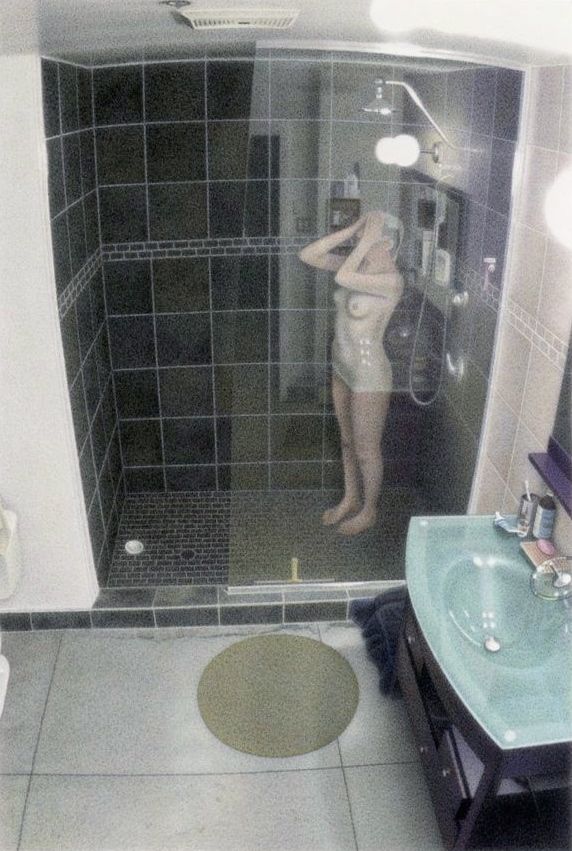
Digital photo 'One Day at Rest' (7:08 am) 02/07/2011.

On July second, 2011, I took more than 7,200 photos of a typical summer Saturday in our condo studio in Montreal. Four cameras, covering virtually every square inch of living space, recorded our existence from our waking at 7 am to lights out at 10:30 pm. The digital cameras were mounted surveillance style from the ceiling and at an interval of seven or eight seconds, one of the four cameras would silently record an image. I also carried a voice activated digital sound recorder throughout the day and recorded over eight hours of audio.

‘One Day at Rest’ is an attempt to further explore my perception of honesty, its nature and role in my work, and a more direct attempt at portraying my physical and psychological existence without the distorting filter that results from turning the camera outwards.

I’ve spent decades sporadically roaming the streets with my camera, subconsciously searching for subjects that reflected my mental state, my unease with the world. Every subject I painted spoke to me in this way, whether trailers, neon signs or derelict commercial buildings.

It took several years to consciously understand that I was searching for a way to reflect my damaged self, except I’d found a way to expose myself to the world without truly giving anything away. I hadn’t intended to perform this psychological dance of the seven veils, I thought at the time I was being pretty direct. I certainly felt the anxiety of the exposed, but a growing awareness of how people perceived my paintings made me realise I was on the wrong track.

In a gallery setting, my paintings look vaguely like photographs. Admittedly, like ink-jet photographs printed on cheap paper in fast draft mode. I’ve often explained to someone hustling past the images at an opening ‘By the way, these are paintings, not photographs!’ People would often do a double take and look a little closer but I began to feel that most were saying to themselves, ‘That could be a photo or it could possibly be a painting but I’m not interested enough to care.’ The current dogma of contemporary art appreciation doesn’t seem to allow for a small photo based painting. Ironic, given the preponderance and apparent popularity of rather dull photographs of abstract collages, photographs of paintings and photographs of photographs. I’m puzzled that people don’t seem to ‘get’ the work but I think they’ve been taught that there’s nothing to get.

When what I do no longer works for me, it’s time for a change. Art is communication and I feel that my message could do with a little reworking. It’s just an old building, how can I expect anyone to get that it represents my tortured soul, that it speaks of impermanence, mortality, alienation, the nature of and value we place on the production of culture? I’ve been hiding behind a facade, sometimes a literal facade, strangely, and it’s time to change how I show myself to the world.

Seventy two hundred photographs of me doing very personal things somehow didn’t make me feel any more exposed than my paintings of buildings or signs. For me, they are the same thing. I hope for the viewer they are something quite different.

Thursday, July 28, 2011

Sea Change


ABC United Trading Corp. 2011 5.5 X 8" Acrylic on illustration board.

ABC United Trading Corp. will likely be my last storefront for awhile. The changes I’ve made to get my paintings into a different realm in New York have had unexpected consequences. This ongoing process of recontextualisation has led me to a surprising revelation: It appears I’ve driven a car into the desert and run out of gas.

I’m not sure when, exactly, I ran out of gas. It may well have been long before I made it to New York for my first show at O.K.Harris in 2004. The twenty year drive to show my work at a good gallery in New York City somehow kept me from knowing that I was no longer inspired by what I painted.

The little ringing voices of truth that I imagine occupy a space just above and behind my head are most easily ignored when life is complicated. The more entanglements my life or career has, the more I ignore them. The blessed silence afforded by the odd confluence of a dying American economy, the strange weightlessness of an unsure venture with a new gallery, and my aching disinterest in my own work has finally allowed the voices to be heard above the din of self delusion.

Art is self exploration. This fact doesn’t always mesh well with a world that prefers to see culture entwined with commerce. The artist’s understandable preoccupation with the financial insanity of this kind of pursuit and the accompanying deviation from the purity of one’s truth is no longer an option for me.

The pressure we place on ourselves, or allow others to place on us, to proceed along a predetermined path to ‘success’ has the effect of eliminating from our lives the insignificant seeming non sequitur, the chance encounter which changes one’s entire direction.

I know now that there isn’t a goal. Only a direction to take and reevaluate when necessary. This is a journey whose length is indeterminate and unknowable and ends only when we ourselves end.

I can choose to find some gas and continue on or I can leave the car in the desert and find another road out. The immense relief I feel as I walk away in another direction is the answer to the question ‘Have I done the right thing?’

Monday, April 4, 2011

Living in Exile


Petemar Enterprises 2011, 5.5 X 8" acrylic on illustration board.

I’ve made two significant geographical moves in my life. The first, in 1989, from Toronto, Ontario to Victoria, B.C. (3397 kilometres). The second, in 2008, from Victoria back east to Montreal, Quebec (3733 km). Both moves gave me a sense of living in exile in one way or another. Both were largely financially driven but each also had an element of escape. The first, escape from the fold of family, old patterns of expectation, the ‘didn’t I know you in high school?’ encounter. The second, a licking of mid-life wounds, an almost random stab at the map for a new place to start again.

Perhaps the urge to move on is an inherited trait. My parents became postwar, economic exiles of Scotland when they made the difficult decision to move to Canada in 1950. Canada was a place of employment opportunities and where one could buy a dozen eggs if one wanted. The latter was no small consideration for a young family living in postwar food-rationed Glasgow.

My father never fully committed his heart to Canada despite spending a large majority of his life here. ‘Home’ for him was more than 5,000 kilometres from the house he shared with us. In a way, he never fully committed to the idea of a home with a wife and three children either. He once remarked to me as we stood looking at the backyard of the house I grew up in, ‘This would be good place to raise a family.’ I thought, ‘Actually, it was. Where the hell were you?’

Sometimes the moving on comes before one is actually ready to leave. Over the last year or two I’ve struggled to understand my place in the art world and tried to sort out why I don’t feel particularly comfortable with the ‘photorealist’ label, despite the obvious connection my work has to the genre. I know that I’ve moved on but I’ve had trouble falling into step with my new surroundings.

Exile is the removal of oneself from the realm of interest that so possesses the person in exile. The removal, which can heighten one’s desire to engage the mind with what was left behind can also, over time, allow for a dampening of the passions. So it is with my dying interest in photorealism.

Montreal isn’t home yet but it probably will be before long. ‘Moving on’ is more of a psychological transformation than a change in one’s address. It’s easy to pack a truck and move oneself physically but the ties one has to a place aren’t so easy to shake from the mind.

Wednesday, December 22, 2010

New Painting: 'House on Marconi'


House on Marconi 2010, 5.5 X 8" acrylic on illustration board.

It’s an odd sensation painting something that one walks by everyday. The subject of ‘House on Marconi’ sits only a few yards from our front door.

Over the last few months, during the daily dog walk, I’ve occasionally been tempted to check out details that were unclear in the source photograph but I mostly avoided looking too hard. There’s an awkward creepiness in paying so much furtive attention to someone else’s house. It’s not unlike developing an obsessive crush on the person who makes your soy latte every morning. Not that I would know anything about that.

Being so deeply immersed in a subject, as one is when spending three months painting it, is an unusual experience. All the more unusual given the prosaic nature of the subject. No one in the ‘real’ world ever spends that much time considering such a quotidian scene.

I have a complicated, subconscious response to my subjects that feels almost physical. It may be the sense of desolation or the inherent, sad beauty of the unremarkable facades but I get a strange feeling in the pit of my stomach when confronted by the scenes that become paintings. They act as clues to some long buried personal mystery, each one giving a sense of bringing me closer to resolution but never delivering a result.

As I sort through my slides looking for the subject of my next painting, I have to constantly remind myself that it’s the pit-of-my-stomach, anxiety-disorder, existential aloneness that I’m painting, not old houses, storefronts, or my neighbourhood. Certain examples of these things can trigger in me the feeling I’m wanting to explore but aren’t, in and of themselves, a reason to paint.

Wednesday, December 15, 2010

Performance Ritual


Recently, I filmed an entire day of my painting process, my ‘Performance Ritual’. It was an exhausting day. I had a long list of shots I needed to illustrate the typical day in my studio beginning with the first few moments after waking at seven to the final marking of my time sheet and extinguishing of my lamp at five.

Much of what I wanted to record was the cycle of activity outside the walls of my condo-studio. In my isolated art-bubble, the daily routines of the mechanics, the body shop, the commuter train, the school bus depot, embrace me as part of the larger world of work. In our previous neighbourhood, a family filled street of brick duplexes and triplexes whose facades ran unbroken from one end of the block to the other, the daily exodus for work or school left the neighbourhood eerily quiet, the conventional nature of life there only accentuating the isolation that an artist can sometimes feel.

I’ve connected ‘work’ with my art since I quit my job to explore the possibility of painting full time in 1983. A combination of guilt and an overblown presbyterian work ethic ensures that my practice is a sober one. I’ve never owned an easel or a palette or worked with more than one brush although I will admit to wearing a beret in snowstorms in the eighties.

My improbable choice of working surface, a metal, sixties office desk and my lifelong fascination for offices and office supplies and equipment no doubt stems from my Father’s long held job at an insurance company whose offices were a repository of oddballs and cranks that I mostly feared and my Mother’s job in the sixties, cleaning offices from which she’d return, late at night, with the discards of Union Carbide: outdated stationery, Eveready Battery signs, battery testers and odd product labels on sheets.

As a child I endured one or two Christmas parties at my Father’s workplace and one staff picnic of which my only memory is getting lost and tearfully searching for my Father among the drunken adults. While the office discards of reams of paper and other supplies kept me busy as a kid, my Father mostly kept this part of his life separate from his family and bred in me a resentment for this other ‘family’.

I’m always fascinated by how well buried are the roots of our present day actions. My intuitive desire to film a day of work juxtaposed with the routines of the workers outside my studio brought home to me, yet again, the connections between our childhood experiences and the sometimes puzzling choices we make as adults.

Monday, December 6, 2010

The Artist's Statement


Rosedale Manor 2007, 5.5 X 8" acrylic on paper.

The artist statement is an odd document. The bastard child of art and literature, often neither artistic nor literate. It is to art what ‘compulsory figures’ were to nineteen sixties figure skating competitions: an adjudicated series of prescribed moves which relate only marginally to artistic expression.

I’ve always resented and resisted the kind of statement that results in successful grant applications. Not surprisingly, I haven’t had many successful grant applications. When I think of a juror on a grant committee, I transpose, in my mind, an elderly East German figure skating judge: a stooped man in a drab overcoat, peering at the cuts on the ice and marking his card in the manner of the juror checking off the currently acceptable phrases and concepts.

Though I’m convinced no one has ever read any of my statements, I’ve always found them to be a good way to crystalise an explanation of what my subconscious is trying to accomplish in my work. A way of conveying to the average person the intent behind a seemingly nondescript collection of images.

My most recent statement for Jim Kempner Fine Art is marginally more ‘art world’ than usual for me but given my new audience and a burgeoning awareness of some long hidden concepts in my process, it seemed appropriate.

Please forgive me for referring to ontology.

*****

Artist’s Statement:

In 1993 I began using photo based imagery in order to eliminate the identifiable marks I make as an artist. In practice, using a single photographic slide as reference and adhering strictly to the information presented in the image is as close as a realist painter can get to objectivity. By restricting my palette (two reds, two blues, yellow and black) the size of the paintings (5.5 X 8”) and by using a single brush (an inexpensive #6 gold sable) I’ve further eliminated many subjective decisions from my process.

I don’t seek out my subjects. They emerge from the periphery of awareness and are almost entirely buildings which have achieved a level of invisibility in their surroundings. The kind of invisibility that heralds transformation: renovation; destruction. I’m interested in the ontological question of being: If it’s ‘invisible’ to everyone, does it exist?

Monday to Friday I work at an old office desk from 9 am to 5 pm. I begin the day by removing the paints from a drawer on my left and placing them on the desk. I remove the painting from a box in front of the desk. At noon I break for lunch and record my morning’s hours on a time sheet that I keep in a drawer on the right. At 12:30 pm I resume working until 5 pm when I record the afternoon’s hours on the sheet. This ritual contravenes the notion of the artist as free spirit, presenting instead the artist as worker, toiling to create an article of cultural consumption. The product is a much fetishised image on board: the average 5.5 X 8” painting requiring 280 hours to complete from a slide exposed at 1/60th of a second, a time factor of 60,480,000 to 1.

I’ve come to accept the folly of hoping to eliminate the self through representative imagery but I’ve managed what is, for me, an acceptable level of detachment from my subject and the physical object of the completed painting through the restrictions I’ve imposed on my process.


Neil MacCormick

September, 2010.

Wednesday, October 20, 2010

The Cliff


Being an artist means sometimes doing what seems most frightening. Normally, the days go by in a pleasant kind of tedium, a feeling that work is getting done. After so many years of refining a process, there’s little to sort out beyond the logistics of how one tackles the next area to be painted. The mind often fixates on other less immediate things like ‘Why is my ankle sore?’ and ‘What the hell is up with my art career?’ The latter question usually precedes a sickly feeling in the stomach and an effort to get back to wondering about the ankle.

Lately, I’ve been thinking a lot about my career. Beyond changing the way the paintings are presented in their frames or the desire to call myself something other than ‘photorealist’, I’ve felt a growing urge to find a new audience for my work. It’s either a hazard of my psyche or my trade but the days spent painting while simultaneously deconstructing every decision I’ve ever made sometimes results in finding a question that needs to be answered: “Can I place my work in the larger context of contemporary art and escape the confining clutches of ‘photorealism’?”

Managing one’s art career isn’t something people talk about. I certainly don’t think it’s something anyone teaches, only the individual artist can visualise the path forward. For me, the persistent itch of dissatisfaction for my lot is what drives most of my career decisions. The ‘itch’ is something I feel is crucial to the development of one’s art, never mind one’s career. Complacency and satisfaction toll the death knell for originality.

With this in mind, I made a bold move and in my ever-expanding search for a new context, I ended my six year relationship with O.K. Harris in SoHo and found a new starting point as the only photo-based painter at Jim Kempner Fine Art in Chelsea. The change came quickly when I finally puzzled out what change was needed. Like a tectonic plate, I can sometimes shock myself and those around me by making an unexpected move.

If we’re lucky and if we’re open to it, life can take us to unexpected places. Two years ago, I couldn’t have imagined leaving the security of O.K. Harris. As I walked out of Kempner, having dropped off three paintings to meet their fate in Chelsea, I felt like I had just jumped off a cliff. I’d set in motion something whose outcome was unclear to me. I walked to the end of 23rd street and composed myself on a bench in the park at Chelsea Piers, assuring myself that I’d done the right thing.

Whether or not my work finds its audience at Jim Kempner, I feel now that the important thing, as an artist, was jumping off the cliff.

Monday, September 27, 2010

New Painting: 'Oriental(e)'


Oriental(e) 2010, 5.5 X 8" acrylic on illustration board.

Oriental(e) is a tofu manufacturer located a short block from our condo/studio. It has that beyond-its-best-before-date look. In our neighbourhood, that means a new condo will rise in place of a freshly razed building and the empty lot next door. The building is, in fact, for sale for less money than we paid for our condo. If not for the intimidating and expensive prospect of converting it to a studio, we’d be buying. Who doesn’t want a garage door entry to their studio? I’m assuming the mice would leave with the dearth of tofu manufacturing but maybe that’s a mistaken assumption on my part. The lot next door might be unavailable to developers as it’s ‘occupied’ by a mysterious person or persons in a tent. In over a year we have yet to figure out what goes on beyond the hoarding that hems in the property. We do indeed live in a curious neighbourhood.

The slide from which I painted ‘Oriental(e)’ was taken after the building’s ‘For Sale’ sign fortuitously blew off in a storm. I hadn’t managed a good photo of the building before the sign went up and I didn’t want a shot of the building with the sign. One of my rules is to use only one slide per painting. The only manipulation I allow to the photo is a subtle cropping to centre the image. I use a slide viewer through which I peer at the small section of the image on which I’m working. The completed image often comes as something of a surprise. Having concentrated for several months on such small parts of it, the whole of the image seems quite fresh to my eyes. I often have to rack my brain to remember which painting I’ve just completed.

‘Oriental(e)’ is a perfect illustration of the transitional building I find so appealing. A nondescript structure just at the edge of its usefulness in a changing neighbourhood. One day no one will remember it was there.

I’ve come to accept that transition is a good thing in ones life. I’m entering year eight in a period of transitions both major and minor in what, I’ve convinced myself, has otherwise been a relatively stable existence. As difficult as it can sometimes be, I think I’ve come to prefer transition’s anxiety, uncertainty and inherent feeling of ‘reality’ to the numbing illusions borne of a desire for stability.

Wednesday, July 28, 2010

Recontextualisation


‘Recontextualisation’ is a word that’s been on my mind for a while. A seemingly simple concept: take something from its normal place in the world and stick it somewhere else. See what happens.

I’ve had a growing feeling that my work needs to be seen in a different way. I don’t feel that I’m doing what other photorealists are doing. I’ve suspected for a long time that my process was more a part of understanding the work than I’ve been giving it credit. I can look back on more than seventeen years of development and finally see some patterns emerging.

I’ve always felt a little uneasy about the ‘photorealism’ moniker. Mention to anyone in the art world, someone who doesn’t know what you do, that you’re a photorealist and watch the look of contempt or pity or disinterest wash over their face. ‘It looks like a photo!’ can be praise or condemnation in equal measure. Non art-world people always love that I paint recognisable images and are happy to share their own version of contempt for the non-objective art forms with me.

I’ve always wanted to paint this way, long before I realised it wouldn’t be a particularly art-world thing to do. I can’t explain my desire, it just always seemed ‘right’ but how does one get people to look past the superficial looks-like-a-photo nature of the work?

It takes me an unfathomably long time to paint a painting. The time commitment has felt more like a burden than a necessary part of the story. Why does it take me twice as long as the next person to paint a similar sized painting? I sometimes feel like an idiot savant, having stumbled upon a process without understanding how it happened.

I’ve finally reached a point where each new painting isn’t taking longer than the one previous. For years the paintings shrank from 12 X 18 inches to 8 X 12 and finally to 5.5 X 8 as I tried to find a way to produce a decent number of paintings in a year. At my last show, Ivan Karp suggested that if I produced more work I could have more shows and wouldn’t that be a good thing? I jokingly said I could produce more if they were smaller. He slowly shook his head and in a quiet voice said ‘No.... don’t make them smaller’.

As I‘ve mentioned in other posts, I record the number of hours I paint every day. I started this as a way of knowing how long it would take to produce work for a show I once had scheduled in Toronto. If I knew how many hours a painting took to paint, I could plot out my work for the upcoming months. Ten years later I still record this information every day. Something in this act relates directly to my practice or I would have stopped. It’s not just a quirk of style that makes my method so laborious.

The other day I made a surprising calculation. If one perceives the average time for the shutter to open and close on my camera as one unit of time then over 62,000,000 of those units are needed to complete the average 5.5 X 8 inch painting of the captured image.

Clearly something strange is going on here.

Monday, June 28, 2010

New Painting: A.B. Demolition


A.B. Demolition 2010, 5.5 X 8" acrylic on illustration board.

My third Montreal painting, A.B. Demolition is part of a trio of derelict buildings on Rue Mont-Royal in our old neighbourhood of the east Plateau. A building so forlorn that even its demolition has faltered.

I didn’t think of the inherent irony in the upside-down ‘Demolition’ sign until I’d finished the painting. In the nineteen-eighties my ex-wife and I used to joke that everything I painted ended up getting knocked down or unsympathetically renovated within weeks of the completion of a painting or drawing.

It seemed uncanny, whether a service station, house or bridge, I had a knack for unconsciously spotting something on the verge of a major transition: a white porceline-enamel skinned Texaco station just before a dumpster heralds its final days; a bungalow which soon finds itself overwhelmed by a cancerous looking addition.

It’s something for which I still have a feeling. I inevitably photograph and paint things which have achieved a certain amount of invisibility in their neighbourhoods. When something becomes so out of step with its surroundings, it will either find itself being revered or destroyed. Sometimes both in quick succession. Incidentally, we do this as well to people who dare to be out of step with the parameters we’ve set for ‘normal’.

No one likes to see the ravages of time these places represent. Nor can we face it in ourselves. We like to move on, renovate and rebuild, not acknowledging our own inevitable decline. Subconsciously thinking that if we do not stay on top of the decay, we’ll soon be overtaken.

The subjects for my paintings are the least likely to be revered. Most will be destroyed in one way or another. They are the architectural wallflowers of the city, representing the unforgiving nature of time. Existing in silence and in their passing unmourned.

Sunday, June 6, 2010

Myth Making


Basic Inquiry Studio 2003, 5.5 X 8" acrylic on paper

It sounds unfathomably naive to me now but in my innocence, or ignorance, I’ve always felt that one day someone, somehow, would become aware of my work and be moved to add me to a volume or article on photorealism, or perhaps review or curate a show of my work.

My art education, such as it is, comes from a meagre selection of books and magazine articles. It never occurred to me that art books could be vehicles for self promotion, a dealer promoting their ‘stable’ or possibly their own holdings of art. I’ve imagined these volumes to be objectively compiled by knowledgeable altruists but they’re actually a product of the highly subjective opinions of a handful of people.

This reality inspired me almost a year ago to start this blog as a way of telling my story. I’ve come to think of it as personal myth making.

It’s taken me a long time to feel that I have a story worth telling or even that I have a story. As the youngest child in my family I believed that life was what happened to other people. An older brother or sister. My mother or father. Surely what ‘happened’ to me was of no consequence. I was the furniture in the room observing other people living lives.

I’ve lived most of my life in isolation. It wasn’t until my life fell apart in 2004 that I realised how isolated I’d been. I found myself, without friends, in a city where I’d lived for almost twenty years. When I forced myself, out of desperation, to leave my house and entertain the idea of connecting with strangers, I found that I had things to share with them. Oddly compelling things. It was easy for me to turn the painful events of my mid-life disasters into entertaining pub conversations. People enjoy knowing some are worse off than they.

I’ve become hyperaware of the stories people tell about themselves. The way we frame our experiences to suit a desired personal narrative. Anyone who is interviewed regularly has concocted a legend which is strengthened in the retelling.

It’s a cruel truth that not everyone wants us to be happy or successful. It’s easy to find oneself being labeled in a way we wouldn’t choose for ourselves by those who, for whatever reason, would like to keep us from fulfilling our goals.

It turns out I really have lived a life. Taking control of one’s own story and giving it an understandable narrative arc is one way of ensuring that no one else decides the narrative for us.

Wednesday, April 14, 2010

The Myth of Sisyphus


A.B. Demolition (in progress, detail 1.25 X 8" 31.5 hours)


Some mornings I can’t face the prospect of yet another day of painting. When I’ve completed a painting and I’m about to start another I often have in mind the myth of Sisyphus. In punishment for innumerable offenses, the gods condemned Sisyphus for eternity to push a boulder up a hill only to watch it roll back down as he approached the summit.

I’m not sure for what I’m being punished but some mornings the dream of being a full time artist feels like a bad idea.

Success has a slippery definition. By many accounts I’m a successful artist. I show at a well known New York gallery. I sell most if not all of the paintings I produce. My prices have gone up more than five hundred percent in six years. On the other hand, I earn less than the hourly minimum wage in Quebec and my work is virtually unknown in my own country or much beyond the narrow sub genre of photorealism.

It’s easy to be envious of the prices other artists receive for their work but it’s rarely mentioned that sluggish sales often accompany lofty prices. I remind myself that the main reason for embarking on a painting career so many years ago wasn’t the allure of untold riches but the promise of self realisation and self direction. There are any number of ways to turn a facility for art into a good income but I chose to make paintings.

Albert Camus said in his 1942 essay ‘The Myth of Sisyphus’: ‘The struggle itself towards the heights is enough to fill a man's heart’. As I begin my second half-century, on those mornings when I struggle to find a reason to continue to care about painting, I remind myself that Camus died in a car accident at forty-seven and that he doesn’t mention with what the heart is filling.

As evidenced by the above photo, I managed to begin another painting. I made my way back down the hill, took a breath, placed my hands on the rock and braced myself to push.

Wednesday, March 31, 2010

'Ghost'


Girl and Fish, 2001 5.5 X 8" acrylic on paper

I stopped painting neon signs in or around 2001. My interest in the subject was killed by the ‘Hooray for neon!’ feelings engendered in viewers. In its place, I was tempted for a time by the graffiti I was encountering in Victoria and Vancouver. I took a lot of pictures and made a few paintings.

For years I had been aware of a graffiti artist in Victoria who tagged his work ‘Ghost’ or less frequently ‘Pawz’. His odd elf-like portraits appeared everywhere. Over the course of a year I painted three paintings in which his work featured prominently.

In the comment book for my show ‘Relic’ at Bau-Xi gallery in Toronto in early 2001, someone wrote in a strange script taking up an entire page: “Victoria... a sleepy little town to perfect a skill. And spooky stories of Beacon Hill Park. Nice Ghost shots, Hans would appreciate it.”

I assumed Hans was ‘Ghost’. I did one more painting of Victoria graffiti before I moved on to other subjects and thought nothing more of ‘Ghost’. I’d stopped taking photos of graffiti altogether.

(Bomb, 2002 18 X 12" acrylic on paper)

In 2002 a small article in a local Victoria paper caught my attention. It described a fundraiser being held in memoriam for Hans Fear. A year earlier, not long after my Bau-Xi show, ‘Ghost’ had hanged himself.

The article explained that Hans had been schizophrenic and had made a conscious decision to stay off his medication because it affected his art.

The story marked a bit of a change in how I saw the graffiti paintings I’d been doing. I was unintentionally celebrating the work of another artist in these paintings. Not that he didn’t deserve the recognition but I began to get a similar feeling of the artist hiding behind a subject as I’d had with the neon signs.

I was haunted by the belated news of Ghost’s death for months and found myself compelled to write a poem:

Ghost

You signed
spray-can portraits
on plywood windows –
an impish girl turned
upside-down
by workmen.

Holding the serrated blade of art
over medication’s flaccid flesh –
a black and hollow face
on a hoarding.

You hanged yourself
on a hilltop
in view of
floating mountains
the canvas of the city
receding below -
your spray lines
fading slowly
or abruptly covered.

Graffiti Creatures, 2000 12 X 18" acrylic on paper

Saturday, March 20, 2010

New Painting: 'House on De Brebeuf'


House on De Brebeuf, 2010 5.5 X 8" acrylic on illustration board

‘House on De Bebeuf’ took me through the bulk of our second Montreal winter. Three hundred and three hours spread over nine or ten weeks. The little house is the only one I photographed in our old unlamented neighbourhood. An anomalous one story building amongst the rickety exterior staircases of the taller duplexes and triplexes that typify the ‘Plateau’.

Winter was easier this year. Our first one in ‘Petite Italie’. The neighbourhood is less frantic than our last which was an uneasy mixture of older, low income renters and flat-screen-hdtv, stainless-steel-appliance-loving, nouveaux bourgeois. This is a strangely calm part of the city with a remarkable array of people from all social strata quietly going about their business. On the weekend when the car shops and meat packers are closed it’s positively sublime.

For the first time I managed to complete a time-lapse video project of the painting process. I knew I’d have to mount the tripod on my desk in order not to forget to take the photos. I averaged three shots a day. It’s easier to understand why the paintings take so long when the video appears to bog down as the brick areas are painted or when the intricate background railings are being sharpened.

I felt a great sense of relief when this painting was done. The video was an added burden that I tired of quickly but was determined to see through.

Something that would complete my bare-it-all painting process, aside from a 24/7 live video feed, would be little notations on my time sheets to explain why I missed several hours of one day or another day altogether. This would complete the picture of process-as-art. The days that I wanted to crawl into a cave and die are surely not irrelevant to the understanding of the work but this facet only exists if I share it.

I have a fundamental desire to leave a mark of my existence that will extend beyond whatever years I have left. Classic mortality complex. I grew up with a profound feeling of powerlessness and invisibility and have a need to leave some trace or proof of my having existed.

The paintings are seed being sown. The gallery, the blog, the videos, the web-site are the cultivation. The crop being harvested is me.